Light Sleeper: Saul Symonds Online Film Journal Issue 2
Saul Symonds ran the online film journal, Light Sleeper, which offered in depth and insightful articles on the cinema.
The content is from the site's Issue 2 from 2006 providing a small glimpse of what Saul offered the site's followers, as well as from other outside sources.
Thank you Saul Symonds.
ISSUE 2
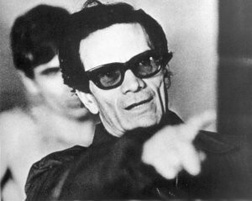 |
| Pier Paolo Pasolini Photograph by Deborah Imogen Beer Gideon Bachmann Collection |
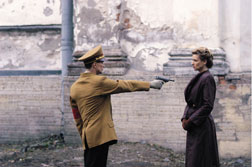 |
| Der Untergang |
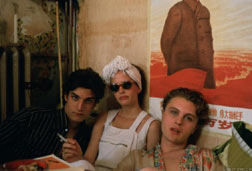 |
| The Dreamers |
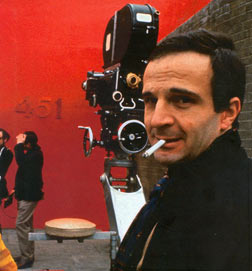 |
| François Truffaut |
 |
| A Talking Picutre |
 |
| Samurai Champloo |
ARTICLES
|
A Roundtable on Salò with David Ehrenstein, Saul Symonds and Noel Vera |
| With David Ehrenstein, Saul Symonds and Noel Vera |
|
I initially submitted this article to POSITIF whose editors’ replied, “We got to the conclusion that the subject of your text really doesn’t fit POSITIF tastes. Almost everyone here hates Salò, and not many are keen on Pasolini's last films in general.” I fully understand their position and their lack of fondness for Salò. I have to admit that I’m not particularly fond of it either. But in the end, I believe that a critic has a responsibility to discuss films by directors’ of Pasolini’s stature, regardless of their personal misgivings or opinions as to the film’s ultimate value. Saul Symonds, |
|
Most film critics and theorists repeat Pasolini’s claim that the film is “a sexual metaphor, which symbolizes, in a visionary way, the relationship between exploiter and exploited.” These repetitions consist of analyzing “Salò” as a sexual metaphor for class struggle and power politics in general, or for Italian Fascism in particular. But the two basic dimensions of Salò – the political and the sexual – can be read both ways. That is, if Salò can be seen as a sexual metaphor of political relationships, it can also and equally be seen as a political metaphor of sexual relationships. In general, film criticism seems to have preferred exploring the ramifications of the political reading, rather than the sexual one. On a number of occasions, however, Pasolini admitted his fascination with the purely sexual dimension of his film. DAVID EHRENSTEIN: And it’s because of this “sexual dimension” the film has been dismissed by all and sundry. Needless to say, aforementioned all and sundry have never read Sade. Had they done so they would realize that Pasolini wasn’t recreating his own sexual fantasies, but rather staging a very small selection of the sexual fantasies inscribed in Sade’s massive, very much unfinished work. It is absolutely imperative to read Sade in order to understand what Pasolini has done with his text. In the three-volume Grove Press edition of Sade’s writings there are photographs of the ruins La Ciste Chateau – the site that inspired The 120 Days of Sodom – taken by Alain Resnais. Resnais was, of course, being a good surrealist. Sade isn’t evoked in his work. Buñuel recreates a scene from Justine in The Milky Way, and in the popular cultural imagination Sade is Patrick Magee. The Marat/Sade is a very important piece of theatrical literature. But the Sade it depicts is quite selective. It’s better, however, than Kaufmann’s Quills, which merely romanticizes Sade – treating him as a naughty book writer. Huxley makes this mistake as well in his otherwise sublime After Many a Summer Dies the Swan. He seems to imagine The 120 Days – which he obviously hadn’t read – was something Marion Davies would have found exciting. It’s not. It’s an impossible book. And Pasolini has made of it an impossible film. NOEL VERA: Not just an impossible film – an absolute, a sort of focal node for the far end of what's possible in cinema. Pasolini takes the text, and (Ehrenstein is right, this should be read first) and infuses it with a breathtaking visual beauty that you do not find in the book, which is a relentless cataloguing of perversions and violence in minute detail that has more of the spirit of the auditor than the artist in it – an obsessive dwelling upon long beyond and way past any notion that this can be in the least bit arousing, much less entertaining. But there’s a fascinating power in Sade’s thoroughness, this need to imagine every kind of horror and present it in a kind of barely credible tableau (the four friends, for one, insist on kidnapping upper-class or high-born victims, and are perfectly confident that there will be no consequence to this). Pasolini’s achievement is to give us a sense, a whiff, of Sade’s thoroughness (as opposed to merely presenting it complete and uncut, which might have resulted in a ten-hour film), then investing it with the kind of aestheticizing transformation cinema can give – Sade’s tableaus, in effect, backgrounded by Dante Feretti’s brilliant colors, surrounded by Osvaldo Desideri’s luxurious sets, scored to Ennio Morriconi, Frederic Chopin, and Carl Orff's music, infused overall with Pasolini’s cool, equally pitiless sensibility. Then, as David mentions, there’s the shift in locale, from some fantasy neverland located outside of France (Resnais may have taken pictures, but I’m sure Sade embellished on the actual location) to a Fascist vacation chateau, equating this kind of horror with that particular regime. Obvious connection, maybe, heavy-handed, maybe, but it does bring Sade up with considerable credibility to the 20th century, the denizens of whom I believe he speaks to the clearest. SS: David, I like the concept of an “impossible film”, a whole category unto itself, kind of like “midnight movies”. But I’m sure what I think of when you say “impossible film” will not be exactly what you think of. How would you define this category? DE: What I'm thinking of relates to Roland Barthes review of Salò published in Le Monde in 1976 (translated in the BFI booklet Pasolini edited by Paul Willemen, 1977) in which he declares: “Pasolini did two things he shouldn't have done. From a value standpoint, his film misses on two counts: everything that renders fascism unreal is bad, and everything that renders Sade real is wrong.” In other words by recontexualizing Sade in the Italian fascist era Pasolini dares us to imagine Sadean acts as historically real, thus spoiling Barthes’ theoretical good times. This is a clear manifestation of bad faith on Barthes’ part. He refuses to see that Pasolini has upped the ante – dared to take Sade’s fantasy into the realm of real, dared to make viewers consider these acts not in a removed context of pristine ahistoricism, but as relating to an understood historical reality. Never forget, Salò is a film made in opposition to “le retro”: The Damned, The Night Porter, Lacombe Lucien, and Le Dernier Metro. Into this chic “nostalgia” Pasolini enters with a plate of shit. Barthes’ seems at the last aware of this, as he ends his piece stating: “This is why I wonder if, as the outcome of a long string of error, Pasolini’s “Salo” isn’t when all is said and done, a peculiarly ‘Sadean’ object: absolutely irreclaimable. Nobody, in fact, seems to be able to.” This is what I mean by “impossible object.” What audience is there for this film? Not the art houses. Not the larger public that embraced Pasolini’s “Trilogy of Life” as a mere erotic fantasy for their delectation. Maybe it was made for his murderers. They killed him because of it, you know. They thought Pasolini was going to set Sade’s “recit” (it’s not a story in any conventional sense) in modern times, ie. Italy 1976. I trust the newly reopened investigation into the murder will make this clear. NV: Interesting that Barthes repudiates the film, since he wrote parts of it. Also, Buñuel not just recreated a scene from Justine, he referred to 120 Days of Sodom in L’Age d’Or, equating one of the four friends in the novel to Christ – a breathtaking piece of blasphemy not Von Trier, nor Haneke, nor Noé has yet to dare try. SS: David, your “plate of shit” works as a pretty deft translation of Barthes’ reference to Salò as a “‘Sadean’ object: absolutely irreclaimable”. It inextricably melds ‘desire’ together with the ‘repulsive’. The Sadean structure of this “plate of shit” is clear, just as it is clear that the larger public will not embrace it “for their delectation.” But I also think that this Sadean structure is incapable of exhausting the film. In fact, I think one of the main problems audiences have is their tendency to see the film wholly in terms of Sade. (There are also problems with the claim that one must be literate in Sade to understand Salò. Does this mean we can only see Pasolini’s film properly if we can read French? And the problem of basing our understanding of Salò on what we believe is the meaning of Sade’s unfinished text becomes even more problematical. In this regard, we should also be aware that our understanding of the sexual relationships in The 120 Days is likely to be contaminated by Krafft-Ebing’s creation and conceptualization of the term ‘Sadism’. In fact, claiming that Sade “should be read first”, as Noel puts it, is like saying you’ve got to be Jewish before you can understand what it’s like to be Christian. The most we can say is that understanding the difference between Sade’s text and Pasolini’s film can generate one way of understanding Salò.) The Jewish/Christian metaphor isn’t that arbitrary: just as Christianity used Judaism as a base on which to build something totally new, so Pasolini builds on Sade’s foundation. Instead of trying to enter Salò exclusively through Sade’s sexuality, we could also try to enter it through Pasolini’s sexuality. I’m thinking of two things here. Firstly, Pasolini shows that politicized sexual relations that can be described in terms of the conceptual structure exploiter-exploited, controller-controlled, etc., are inhuman, corrupt. The implication is that the one condition for a truly human sexual relation is its lack of an oppressive hierarchical political structure. Secondly, one of the ramifications of Pasolini’s critique of large-scale political control surely has to be the political control of sexuality. It’s hard to believe that Pasolini, given his homosexuality, did not feel the arbitrary hand of an oppressive power in society’s insistence that heterosexuality was the one condition for a truly human sexual relation. NV: On reading text and watching films – I’d agree that watching the film without reading the book isn’t the only way to approach the film; however, I do believe it’s the most fruitful, the most promising. When you look at Sade’s text – obsessive, repetitive, in some parts actually dull, an extreme, uncompromising text in every way, it’s fascinating (perhaps somehow even distracting, if you like) to see what Pasolini adds or subtracts from it. To the shock of the extreme, Pasolini adds the shock of realism (a plausible scenario), and the shock of beauty (the lighting, colors, décor). I’d also further qualify that “Judeo-Christian” metaphor. Where Christianity would undoubtedly claim that they’ve improved on Judaism, I’d disagree – if the transformation were such an unqualified success, why is Christianity accused of so many crimes, and why do so many Jews remain unconverted? The Christians have merely modified Christianity to suit their particular (even, from where the Jews are sitting, heretical) needs. Likewise with 120 Days the film over 120 Days the book – it’s made compromises, reduced the text, changed it considerably, to become its own entity, in an entirely different medium, and it has paid a price in some ways (you lose some of that extremism, for one). It's not so much an improvement as an interpretation, albeit one remarkably faithful to its source. Something else on which I wish to disagree with/qualify somewhat/develop further: I can see where you’re saying that Pasolini is trying to make the political point that sexuality under the shade of repression isn’t true sexuality (the metaphor carried further, life under the shade of repression isn't true living, either). I can certainly agree with the general outline – repression and in particular political repression is largely not fun – but I'm not sure everyone will agree that repression doesn't have some kind of heightening effect on sexuality. Erotic literature thrived under British culture in the Victorian age, and as a Filipino living in a Filipino society, where even the suggestion of a woman having had more than one lover, or a lover that isn’t her husband, is still shocking, repression, in this case social repression, does have the effect of spicing up one’s sense of the erotic – adding a sense of the forbidden to one’s sexual activities. Add to that the possibility that the repressed or the dominated or even the victims of sexual acts might at times collaborate, seek out, even enjoy the various acts of sexual domination/repression/violation describe by Sade (and Sade, as we’ve noted so many times here, is nothing if not comprehensive), and the picture may be more complex, or even more perverse than you might initially suggest. DE: But then hasn’t Pasolini always wondered what “true sexuality” consists of? His relationships were invariably with men outside of his class, age-range and intellectual authority. Yet he never really sentimentalized this situation – though Gary Indiana in his otherwise excellent book on Salò accuses of precisely that with Ninetto Davoli. Of course Indiana also makes clear that Ninetto isn’t his type and therefore he’s out of sympathy with Pasolini from the start. However Indiana goes too far in his assumption of romantic despair on Pasolini’s part in the wake of Ninetto getting married and starting a family. Pasolini’s poetry makes clear that he knew this was in the cards. And to a large degree “Fiori di campo” in which God kills Ninetto, quite arbitrarily, is Pasolini’s way of dealing with this. Moreover their relationship, while no longer sexual, never ended. Ninetto was the last close friend to see Pasolini alive. They had had dinner the evening of the murder. Over and above all, Ninetto doesn’t appear in Salò. Pasolini would have had been forced to cast him as either a victim or an executioner, and he couldn’t bear that. Indiana tries to make the case that one of the actors looks like Ninetto to some degree and is therefore a stand-in. But it won’t wash. SS: This one’s for Noel: in Salò sex ain’t just “under the shade of repression”. On the one hand, we have sexual relations that are structurally fascist; on the other, we have a critique of all political power that I think in Pasolini must, (though this is rarely?/never? mentioned), implies a critique of the use of any society’s political power to control sexuality. And this control is not simply material, (i.e. through laws, courts, police), it’s ideological. It’s the sort of oppression, to paraphrase Pasolini, that ‘steals your soul from you’, (i.e. there’s no opening for heightened eroticism here). It consists in the god-like role that society appropriates for itself when it presumes to define the true nature of things. In relation to society’s control of sexuality it consists of equating ‘heterosexuality’ with ‘natural’/‘normal’/‘healthy’/‘good’/etc and ‘homosexuality’ with ‘unnatural’/‘abnormal’/‘unhealthy’/‘evil’/etc. This one’s for David: if “Pasolini always wondered what ‘true sexuality’” was, then I think we have to ask how this helps us to understand Salò. At the beginning of this session you pointed out that Pasolini isn’t recreating his own sexual fantasies in Salò, but is staging Sade’s sexual fantasies. Why? Pasolini’s own answer is that the fascist nature of Sade’s sexual relations allows them to function as a metaphor of power. But the moment he uses these sexual relations as a lens to help us see the true nature of power they go beyond what Sade intended and, in fact, take on a decidedly un-Sadean moral dimension, (and I don’t mean that Pasolini makes moral judgments on Sade’s material, because he doesn’t – the moral dimension I’m referring to is implied in the structure of Pasolini’s metaphor). But there’s something else behind Pasolini’s faithful re-presentation of Sade’s orgies. The shocking realism of these orgies, (which you both pointed out earlier), is, I think, designed to be ‘unwatchable’. This brings us back to the idea of Salò as an “impossible film”: we watch what we can’t watch, and the result is that it repels us. But in what direction? We can endure these scenes more easily when we are aware that they are functioning like a window or mirror that we look through or beyond to see something else, (in this case ‘power’). But Pasolini’s realism continually undermines this allegorical function and forces us to see unwatchable sexual humiliations which repel us in a direction that may lead us to wonder what a true human sexual relation might be. DE: A lot of this stems form what can only be called Pasolini's disappointment with his success in “The Trilogy of Life.” Clearly he wanted these films to be something more than “sexy movies.” But that’s the level on which they were consumed, world-wide. Inevitably this led him to contemplate what it would be like to make a film that isn't consumed so easily. And Salò is most definitely that film In his “repudiation” of the trilogy Pasolini writes “the progressive struggle for sexual expression and for sexual liberation has been brutally superceded and cancelled out by the decision of consumerist power to grant a tolerance as vast as it is false.” He goes on to say “private sexual lives (like my own) have suffered the trauma both of false tolerance and of physical degredation, and what in sexual fantasies was pain and joy has become suicidal disappointment, shapeless torpor.” Clearly Salò is about torpor – but it has a definite shape. “Suicidal disappointment” has of course been seized upon by Pasolini's enemies – even though he was referring to a class of gay as a whole, not just himself. That class has in fact embraced a consumerist plan of “tolerance” accompanied by the illusion of “privacy” – something Pasolini, who never in his life was granted any should have known better than to invoke. NV: Just to add to my previous comment: Of course, I must admit that Sade doesn't depict that kind of psychology in 120 Days that, in fact, he doesn’t depict much psychology at all; at most, we have the philosophy justifying the four friends’ acts explicitly laid out, though what actually goes on in their heads is ignored in favor of what they actually say or do. For a more thorough exploration of the nature of sado-masochistic relationships, I'd say Dominique Aury’s (a.k.a.) Pauline Reage’s The Story of O, written in the more sophisticated, post-Freudian 1950’s is a better bet – it shows that there’s a dynamic between the dominator and the dominated, that one is every bit in need of and wields power over the other, whatever their ostensible role might be. Interesting to further note that the film that best captures O’s spirit and sense of danger for me isn’t Just Jaeckin's soft-core porn adaptation, but a Filipino film: Init Sa Magdamag (Midnight Passion, 1983) – written, interestingly enough, by a woman (Racquel Villavicencio), directed by a woman (Laurice Guillen) and starring a woman (Lorna Tolentino), perhaps the finest erotic film ever made in the Philippines. Women, it seems have a knack for understanding the subtleties of power relationships. Saul, I definitely don’t disagree that apparently part of the reason Pasolini transposed the story from France in Sade’s time to Italy under the Fascists is to make a connection between political and sexual repression – that sexuality is yet another field of human activity that the Fascists, among others, have sought to control. But just look at the film: the will and freedom of everyone in that chateau is circumscribed and manipulated to exact specifications; everyone is under strict and comprehensive control…except for the very four “protagonists” (I use that word for want of a better one) that instigated the whole orgy in the first place. It’s their will that's being done, their sexuality that’s being fulfilled, and, evidently, their sense of the erotic that's being heightened to the nth degree. If you want to talk about repression of freedom or rights, you can't include their freedom, and their rights. But to extend that thought further – you’ve got around sixteen prisoners (plus the wives, who are practically prisoners), and four masters: surely sixteen youths and four grown women can escape from four decrepit old degenerates? They don’t, of course, and that’s because the four are helped by a number of servants, chaperones, guards, what have you, who also participate in their own way. So the whole thing really works if the victims are a numeric minority and the four friends and their collaborators are the majority…meaning more peoples’ sexualities are involved, and not in a repressed or victimized capacity. As for the victims…I’ve mentioned the psychology behind victims and the dominated, and The Story of O. It might not be the case for every one of the prisoners, but I submit that it could be the case for some of the prisoners, some of the times. I do think it would be more accurate, or perhaps more useful to say that Pasolini presents to us the eroticism, the sensual pleasures of absolute power as it might have been possible under the Fascist regime: that what we’re seeing is a tidal pull exerted on the will of almost everyone in a country – or in this case, a chateau – to fulfill the wishes of a minor but powerful few. I’d try go ahead and tie in what David is saying: that the kind of torpor, that kind of disappointment (and in fact, two of the four friends have difficulty achieving erections, or orgasm) Pasolini describes is what gave rise to this kind of hunger for power, and the need to exercise it just so. What Pasolini channeling Sade is saying is that the flip side of Sade’s sexual sadism is sexual impotence, and the flip side of desire in Sade’s mind is boredom with conventional sexuality – that boredom and impotence, and not sexual orientation, are what truly drive destructive or extreme sexuality. DE: And what enrages the four friends the most is any expression of genuine sexual tenderness. For them sexuality and brutality are one and the same. Remember how Pasolini ends his film – with the two boys dancing, a moment of tenderness that wouldn’t have been out of place in a Bresson movie. No irony is intended either. Consequently we’re left to wonder what will become of these boys. A fair question. SS: In my own mind this question tends to take the form: why did Pasolini choose a final moment of tenderness for Salò? A more interesting incarnation of the same question might be: why, in a film in which all music is diegetic, does Pasolini let us hear the same music in this final scene as he lets us hear playing over the opening credits? This piece of music closes a circle, and locks a moment of tenderness (?) into the structure of despair. NV: That’s true, tenderness was a serious crime for them, any expression of love in fact, and they dealt with it quickly and cruelly. Perhaps the most electric moment for me was when the young girl – Pasolini picked the freshest, most innocent face possible, something Sade might have done, and which the four friends had already done at the start of the film – and had her sit on the floor, weeping at the thought of her dead mother. The four friends were dumbfounded: this was the most flagrant defiance of their rules that they had yet seen. Her punishment, of course, befitted her crime – if love came out of her mouth, the exact opposite will be fed into it. DE: Interesting too that Indiana mistakes that piece of music for These Foolish Things. The tune Pasolini chose (with the help of Ennio Morricone as usual) sounds a bit like These Foolish Things, but isn’t. I'm sure it’s a tune Pasolini recalled from the period. It denotes a sense of casual calm before the storm of grotesque torture to follow. Calm returns at the end as the boys dance. But can no longer accept this image at face value as we might have had it opened “Salò” rather than closed it. SS: The first image of a film is always difficult to construe. A film begins at the point that we first become aware of what is happening. In Salò this point might come when we see the boys being rounded up and notice the dead body lying in the middle of a large courtyard, or it might not come till the libertines read out their Laws. But wherever the beginning begins it has Dante’s words branded into it: “lasciate ogni speranza, voi ch’entrate” (abandon all hope, you who enter). NV: Going back (or circling back, if you like) to tenderness and love and their violent reaction to it, I suspect a vital clue as to why this may be can be found in the Laws read out by the four libertines: at one point they say the utterance of the word “God” will be punished by the worst penalties. Expressing love and/or tenderness would have been tantamount to expressing God (in Christian and many other religions one is the equivalent of the other), and the libertines would not tolerate the mention of one whose powers they have decided to usurp. DE: But what cannot be tolerated in the world of Salò is not God but the People. No “solidarity.” No thought of the pain and suffering of another person – save to enjoy said pain and suffering. No “revolution.” What disturbs Pasolini is his own doubts concerning “the People” and his disbelief that “Revolution” was truly possible. SS: I wonder if I wasn’t mistaken all along. Has Pasolini simply mislead us with all this talk about politics? The chateau is a Dantesque Hell – the inversion of every value. Why did he want to create this cinematic inferno? Barthes tells us he made two mistakes – two and not three, two and not one – he is quite precise. But unless Barthes has certain knowledge of what Pasolini wished to achieve with this film, then he has no measure by which to judge its success or failure. And Barthes is characteristically silent on this point. Did Pasolini really make Salò to critique political power? As a metaphor of power Salò really doesn’t tell us anything exceptional. On this level, it’s all very ordinary. As an inferno, however, it is deeply convincing. I am beginning to suspect that Pasolini’s ‘fascination’ with this inferno may be personal in a way we have not yet articulated. NV: Now this is interesting – I think it's pretty clear to Sade that it’s God his four heroes (for want of a better term) are proscribing, and I believe David's right in that Pasolini has probably imposed on his adaptation the idea that it’s the People they’re trying to banish from their chateau, and all this naturally has Saul confused, or at least in doubt. God or the People? Sade or Pasolini? Whose vision, and whose interpretation, prevails? Saul, if I interpret your last comment correctly, feels it’s possibly Sade; I think it’s an interesting dynamic between the two viewpoints that leaves the film in an ambivalent state – not so much confused as constantly changing, struggling, in a state of flux. SS: Gideon Bachmann noted (in the 70’s) that “where de Sade attacks God and Nature, Pasolini attacks power and exploitation”. Nothing confusing about that. I meant what I said: “Pasolini’s ‘fascination’ with this inferno may be personal in a way we have not yet articulated,” (that is, in a way that is neither political nor Sadean) DE: Let us not forget that Pasolini had post-Salò plans. He was going to make a film about the Apostle Paul set in contemporary New York – which he visited in the 60’s and where I had the great pleasure of meeting him. We had a serious conversation about art and politics – after which Pasolini went on to explore the not inconsiderable pleasures the city had to offer a gay man at that time. |
The hopeless (yet Christian) world of Pier Pasolini’s ‘Salò, or The 120 Days of Sodom
Eve Tushnet August 23, 2019 | www.americamagazine.org/
Pier Paolo Pasolini in 1964. “Salò, or The 120 Days of Sodom,” was the last movie Pasolini filmed before his murder. (Wikimedia Commons)
There are 13 directors whose films are recommended by the Vatican for their depiction of religion, but not all led lives notable for their sanctity. And one went on to direct the most notorious art film of all time. It is unlikely that the Vatican will ever praise “Salò, or The 120 Days of Sodom,” the last movie Pier Paolo Pasolini filmed before his murder. Yet that film’s anthropology—its account of what it means to be human—is even more uncompromisingly Christian than Pasolini’s 1964 “The Gospel According to Saint Matthew.” “Salò” depicts a world of Christian anthropology without Christian eschatology—a world where human beings are made in the image of God, and there’s no hope.
Pasolini called “Salò” his first film “about the modern world.” By contrast, his “Gospel” is a mix of peasant piety and Marxist class analysis, with a Jesus more prone to haranguing than forgiving. Pasolini defended the film’s few miracles—among its most effective scenes—against criticism from Marxist comrades by saying he wanted to represent the “subjective reality” of the Italian peasantry. Many of his films show this desire to enter into (or project onto) a peasant or premodern imagination, including the “Trilogy of Life” that immediately preceded “Salò.”
The films in the “Trilogy of Life” are all, like “Salò”(and like “Gospel,” with its parables), adaptations of works in which the act of storytelling plays a central role: “The Decameron,” “The Canterbury Tales” and “Arabian Nights.” They work well as a trilogy; they are lush and loping, urgent and optimistic, with just a hint of memento mori. Sex is play. Consent is treated casually since all young beautiful people inherently want to couple with all other young beautiful people. Nobody gets pregnant. The storytelling framework, to the extent that it has any thematic purpose, creates a Vegas feeling of freedom: The tales are colorful, amoral cities that bloom in the desert of reality by sheer force of human imagination. The three films are too haunting and strange to be merely silly—but too banal in their view of human nature to be fully sublime.
The film is aggressively artificial, and yet the artifice offers no protection for the audience.
Pasolini came to repudiate these films, in an essay called “The ‘Trilogy of Life’ Rejected,” and “Salò” is often treated as the fruit of that repudiation. When Pasolini talked about “Salò” he expressed fury at the contemporary world. He lamented the way the sexual revolution had ossified into its own rules and expectations: “Sex today is the satisfaction of a social obligation, not a pleasure taken against social duty.” He found pop culture more threatening than political repression: “[T]he real violence is television.”
Pasolini made “Salò” sound programmatic. Censors and audiences initially treated it as pornographic—but disappointingly unsexy. “Salò” was the subject of lengthy court battles (during an era when Italian theaters happily showed films with titles like “Too Nude to Live”) and the film critic Naomi Greene recalled, “When I finally saw “Salò”in my Roman neighborhood movie house, I remember hearing cries of brutto (“ugly”) from dismayed and disappointed viewers.”
“Salò” is ostensibly set in a real time and place, a short-lived fascist “republic” created by Benito Mussolini under German occupation. This was a controversial choice (fascist rule was well within living memory) and may seem like a distracting one, given that most of the film takes place in the enclosed, fairy-tale world of a villa taken over by the fascists. The rhetoric of the public officials (The Duke, The Bishop, The Magistrate and The President) who control the action moves freely between actual fascist slogans and rules taken from the Marquis de Sade’s writings. The film claims a kinship between real and imagined deaths; this, in fact, is its central philosophical claim, that political and pornographic dehumanization are the same kind of fantasy.
At the start of the film the officials, with the help of three storytellers and various accomplices, select a group of 18 local youths of both sexes. These victims are told the rules “that will govern your lives”: heterosexual intercourse will be punished by mutilation, and “the slightest religious act committed by anyone will be punishable by death.” The rest of the film takes place inside the villa, moving with Dantean relentlessness from the “Circle of Manias” to the “Circle of Shit” (featuring the film’s most infamous sequence, a coprophagic wedding banquet) and at last to the murderous “Circle of Blood.” Each movement of horror and domination is preceded by storytelling. The storytellers, all women dolled up in gowns and furs, describe their adventures in prostitution. They play up how much they loved the degradations they recount, and these stories excite the officials to enact various cruelties on the youths. The storytellers’ own helplessness emerges only in glimpses, as when one of them conspires with the silent piano player to rescue a girl from execution by performing a bizarre comedy routine. The overwhelming emotion of “Salò” is dread.
The film is aggressively artificial, and yet the artifice offers no protection for the audience. The Cubist art on the walls, the gowns, the tales, the piano, the sheer absurdity of scenes like the pagan drag “wedding”—none of it offers the relief of camp. When the fascists scream at their victims to laugh, it isn’t funny. The absurdity is abusive—you can’t reason your way to an understanding of us or a prediction of what we will do to you.
In “Salò,” spectatorship is domination, and the viewer is a complicit spectator. Many scenes are framed by doorways and windows; the shots often place the action at the exact center of the frame but far away, calling maximum attention to the camera eye. But the film resists the audience’s desire to see and linger. Pasolini does us the great kindness of making the film unpleasant to watch. (You can tell it is not pornographic because nobody enjoys it!) Physical violations are typically filmed from afar and with the victims’ bodies obscured. “Salò” offers a lesson in how to depict cruelty without re-enacting it—a lesson few filmmakers even want to learn. Nor do we get to know the victims as people. To give them personalities might imply that these personal characteristics are what make their suffering horrific. In “Salò,” it is simply the fact of their humanity that makes their degradation wrong.
There are two moments when the film “breaks character.” One guard is caught having consensual, heterosexual intercourse with a servant; before the officials shoot him, he raises his fist in a gesture of protest and the powerful men fall back, momentarily disconcerted. This is the one sentimental element in a film that otherwise offers no comfort to the audience.
And there is a moment toward the end when a girl, sitting naked in a tub of the victims’ excrement, cries out in anguish, “God, God, why did you abandon us?”—as the guards outside the door play cards. This allusion to Jesus’ cry from the Cross, and to the soldiers who diced for his clothes, is the one moment when Christianity appears in the film’s structure—as a story the film is telling or at least relying on to express a truth, rather than merely as a belief held by some of the victims.
The overwhelming emotion of “Salò” is dread. (The second time I watched it I was startled at the brevity of many of its most searing scenes.) The storytelling exists to provoke anticipation in both officials and audience—and dread in both victims and the audience. Dread is torture that takes place in the imagination; and “Salò” is, above all, an attack on the imagination. The essence of torture is not violence or physical pain but the dehumanization that necessarily precedes any cruelty. Torture requires a story in which the victims deserve it, do not matter, are objects, are fungible and available for consumption. The closest cousin to “Salò” is not another ’70s Italian rumination on the sexuality of fascism, like Liliana Cavani’s “The Night Porter.” It is Joshua Oppenheimer’s 2012 documentary “The Act of Killing,” in which he encourages members of Indonesian death squads to re-enact their killings in increasingly flamboyant scenarios, revealing the influence of Westerns and gangster flicks on the killers’ self-concept. This repeated storytelling brought some participants to doubts and remorse, though they had initially used storytelling to defend against repentance.
“Salò” is less hopeful: a story, woven from stories, about the power of stories to destroy.
My note: I was after reading the 2019 article in the America Magazine entitled The hopeless (yet Christian) world of Pier Pasolini’s ‘Salò, or The 120 Days of Sodom that I decided to do some additional research about Pasolini's last film. I especially enjoyed reading the Trivia Notes from IMDb. One of the more in depth articles I saw was written in 2013 by Christopher Sharrett which you can read at: http://sensesofcinema.com/2013/cteq/salo-or-the-120-days-of-sodom/. I decided to buy a DVD of Salo: or the 120 Days of Sodom. I was rather surprised to see you could buy it at Target, but Amazon Prime had the best selection of a number of Pasolini’s films.
I invited a few film buff friends over to watch with me. For some reason we got into an argument, or rather a heated conversation about reality and our perception of it. This became a philosophical discussion about meaning of nothingness, or how one's understanding of nothing guides your understanding of reality and the question, "What is nothing?" Film buffs seem to be especially susceptible to these kinds of metaphysical diversions. Several bottles of wine and food were set out on a low table which was easily accessible to all, including, unfortunately my dog. Maxis is usually respectful of my command to "stay" or "leave alaone", but not this evening. I am not sure it was the sandwiches which drew him to the table or the wine. I suspect it was the sandwiches which required him to remove the offending red wine bottle which landing on the rug with a full glass of wine spilling as well. He never reached the sandwiches since I lunged and grabbed him, but the damage was done. Red wine on a wall to wall carpet. Not good. The film was paused as we cleaned up.
The next day I did a search for on premises rug cleaning NYC and lucked out finding Agara Carpet Cleaning. Although they specialize in cleaning antique rugs and all types of handmade rugs, they also will come in a clean carpets. In my case they rolled the carpet up and took it to their factory where it was cleaned. Honestly I was impressed when they brought it back. I hadn't realized how dingy it had become. It looked like new.
As far as the evening went: on just viewing the film, I was surprised, repulsed, and just at a loss as to how the director could have possibly ever gotten permission to, let alone gone through with (and found actors to participate in) ANY of the acts and scenes portrayed in this film. It seems if one has a good grasp of the socio-economic and political situation of Italy in the 1970's, one has a better handle on what Pasolini was intending. But even the commentators, who knew Pasolini at the time have differing views about the movie. So I don't feel so bad about not coming to a conclusion about the movie. To be sure, we had a lively discussion after the film ended arguing about motivation and interpretation.
Salò, or the 120 Days of Sodom (1975) IMDb Trivia
Despite the grim subject throughout the film, in an interview on the second disc of the Criterion Collection box set, actress Hélène Surgère claimed the mood was actually rather jovial on the set and that none of the teenage actors were actually harmed or traumatized. She said the abundance of teenagers who had never acted before led the mood to be happy and at times, even fun, with the cast often playing practical jokes on each other. She also said that the movie was literally "made" in the editing room and the filmmakers had no idea how grim a movie it was until they saw the finished product at the premiere.
+++
Salo is a town in northern Italy which Benito Mussolini's Fascist government effectively made their capital from 1943 until they fell from power in 1945. The place had particular relevance for Pier Paolo Pasolini because his brother was killed there.
+++
Pier Paolo Pasolini was murdered before the film's release. A 17 year-old hustler, Giuseppe "Pino" Pelosi, was arrested when he was found with Pasolini's car. He admitted running over Pasolini several times with the car after an argument, and end up convicted of the crime. Many years later, he denied participating in it, claiming that three mysterious men were involved. The case remains unsolved.
+++
When the movie premiered in West Germany in February 1976 it was confiscated by the state attorney in order to ban it. The district court of Stuttgart classified it as pornographic and violence-praising. A few days later, though, that ruling was reversed and the film was allowed to be distributed nationwide.
+++
Roger Ebert owned the film on LaserDisc for years after the film's release, but never watched it because he was intimidated by the graphic content. He supposedly died without ever watching it.
+++
The film had an extremely limited release worldwide, and was banned in many countries. It got a wide release in Sweden in 1976, and sold 125,000 tickets, meaning 1.5% of all Swedes saw the movie. It also grossed more than The Omen.
+++
Even now, some 40 years after its release, the film remains banned in some countries.
+++
Ennio Morricone, who composed the jazzy soundtrack, said he was very uncomfortable watching the movie. He only agreed to score the film due to being friends with Pasolini.
+++
Unsure how to bring his film to a proper conclusion, Pier Paolo Pasolini shot 4 different endings.
+++
An attempt by Sky TV to televise the full uncut version in 1991 was vetoed by the BBFC. It thus became the only film to be rejected for TV screening amongst the works submitted by Sky.
+++
One of the favorite films of directors Michael Haneke and Gaspar Noé. John Waters is also a fan.
+++
"Salò", in the title, refers to a town in Lake Garda where the film is set. Italians think of Salò as a reminder of the horrors of Benito Mussolini and his fascist regime.
+++
First part of Pier Paolo Pasolini's "Trilogy of Death". The subsequent two parts were never filmed because Pasolini was murdered a few months after he had finished this movie. The trilogy was intended to complement the previous "Trilogy of Life", including The Decameron (1971), The Canterbury Tales (1972) and Arabian Nights (1974).
+++
The British Board of Film Classification rejected the film in 1975, making it technically illegal to show in the UK. When an arthouse cinema in London showed it, the film was confiscated in a police raid. In 2000, the BBFC revised its opinion and gave it an "18" certificate, for adults only.
27 of 27 found this interesting | Share this
When Pier Paolo Pasolini was asked who is the film's audience, he said, "It's for everyone. For people like me."
+++
The story is divided in an "Antinferno" (Hell's vestibule) and three "Gironi" (Hell's circles). This structure is a reference to Dante Alighieri's "Inferno".
+++
The film only earned proper censorship approval from the Australian authorities in 2010.
+++
The notorious scene where a young woman is forced to eat excrement was intended by Pier Paolo Pasolini as a metaphor for consumer capitalism and the rise of the junk food culture.
122 of 136 found this interesting | Share this
The song sung at the meal is "Sul ponte di Perati" ("On the Bridge of Perati"). This is an Italian Second World War song, based on a First World War song ("Sul ponte di Bassano"). It commemorates a battle involving the 3rd Alpini Division Julia, of Italy's alpine mountain infantry corps. It commemorates the major battle at the Perati Bridge between Greece and Albania, involving Greek and Italian troops.
13 of 13 found this interesting | Share this
The original August 1998 Criterion Collection DVD was removed from the market due to copyright problems, allegedly concerning a dispute with Pier Paolo Pasolini's estate. This version of the DVD with the "white ring" around the spindle hole was known to sell for $600 (US) or more in good or new condition during the early 2000s. This makes it one of, if not the most, valuable DVDs in the world. However, selling prices on eBay as of 2013 are greatly reduced, due to Criterion re-releasing the film in new DVD and Blu-Ray editions. Bootlegs are still common due to the original printing's value, and research should be done before purchasing.
+++
In 1994, an undercover police officer in Cincinnati, Ohio, rented the film from a local gay bookstore, then later arrested the owners for "pandering". A large group of scholars and artists, including Martin Scorsese and Alec Baldwin, signed a legal brief arguing the film's artistic merit. The court dismissed the case because the police violated the owners' Fourth Amendment rights, without addressing the question of whether the film was obscene.
+++
Several books are quoted throughout the movie, including Friedrich Nietzsche's "On the Genealogy of Morality" (1887), Ezra Pound's "Cantos" (1922-1962), Marcel Proust's "In Search of Lost Time" (1913-1927), and a poem by Gottfried Benn.
+++
Included among the "1001 Movies You Must See Before You Die", edited by Steven Schneider.
+++
One of the top ten favorite films of director Rainer Werner Fassbinder.
+++
Pupi Avati made some uncredited contributions to the script.
+++
One of actor David Cross' favorite movies
+++
The bibliography given on the opening title is: Roland Barthes, "Sade, Fourier, Loyola" (1971); Maurice Blanchot, "Lautréamont et Sade" (1949); Pierre Klossowski, "Sade, mon prochain" (1947); Philippe Sollers, "L'écriture et l'experience del limites" (1968); Simone de Beauvoir, "Faut-il brûler Sade" (1955).
+++
Maurizio Costanzo worked on an early version of the script.
+++
In at least three scenes, when the four "villains" enter a room, they walk over a beam of light that's coming from outside.
+++
Screened at Locarno International Film Festival in 1976 in the "Programme principal / Longs métrages Hors compétition" section. It won the International Critics Special Award.
+++
The opening title include an "essential bibliography" compiled by director Pier Paolo Pasolini: -Roland Barthes. "Sade/Fourier/Loyola," 1971. Trans. Richard Miller. Baltimore, Maryland: Johns Hopkins University Press, 1997; -Maurice Blanchot. "Lautréamont and Sade," 1949. Trans. Stuart Kendell and Michelle Kendell. Stanford, California: Stanford University Press, 2004; -Simone de Beauvoir. "Must We Burn Sade?" 1955. Trans. Annette Michelson, in "The 120 Days of Sodom and Other Writings". New York, New York: Grove Press, 1966; -Pierre Klossowski. "Sade my Neighbor," 1950. Trans. Alphonso Lingis. Evanston, Illinois: Northwestern University Press, 1991; -Philippe Sollers. "Writing and the Experience of Limits," 1971. Trans. and eds. Philip Bernard and David Hayman. New York, New York: Columbia University Press, 1983.
+++
There's an unconfirmed rumor which says that the uncredited actress who plays the first female victim is Claudio Troccoli's sister.
+++
During the filming, the crew played a football match against 1900 (1976) crew, which was directed by Pasolini's friend and disciple Bernardo Bertolucci.
+++
Adaption of the book "120 Days of Sodom" written by French writer Marquis de Sade in 1785. The book was not published until 1905 due to its extremely sexually graphic and violent nature.
+++
Pasolini was in mind three of his regular actors and friends to do some parts, but for fear of reprisals due to the character of the movie, Pasolini preferred deny them the parts.. Laura Betti was chosen to play Signora Vaccari, Ninetto Davoli was chosen to play Claudio the collaborationist, and Franco Citti was chosen to play one of the guards. In Betti's case, she also had to refuse the part because her commitments to the movie 1900 (1976). However, Betti dubbed Hélène Surgère's voice as Signora Vaccari, and Davoli worked as an uncredited assistant director in some scenes.
Is this interesting? | Share this
This film is part of the Criterion Collection, spine #17.
+++
Spoilers
The trivia items below may give away important plot points.
The "excrement" in the coprophagia scenes was a mixture of chocolate, orange marmalade, and some other clashing ingredients. The disgusted reactions were real.
+++
The Japanese Region 2 DVD, released in 2002, contains several production photos not seen in any version of the film, including a girl strapped into an electric chair (presumably during the final scene), and the victims' bodies arranged in two rows, some covered with sheets, in the courtyard.
+++
In 'Sul Ponte Di Perati' scene, two male victims appear singing. They are the only two male victims who survive at the end.
| Masters of Horror: Dario Argento's "Jenifer" |
| Reviewed by Saul Symonds |
Director: Dario Argento Written by: Steven Weber Based on the short story by: Bruce Jones Original music by: Claudio Simonetti Main Cast: Steven Weber, Carrie Fleming Country: USA First Aired: November 18th, 2005 Running time: 60 minutes |
|
A common point made about Argento's movies is that he eroticizes murder. It's a point that could probably be made about most horror films, even ignoring the fact that many seem to revolve around men who are obsessed with plunging sharp deadly objects into the bodies of, mostly young, women. Not surprising, then, that like most masters of horror Argento has been accused of being a misogynist. In many Argento films it is frustrated desire that leads to a murder which can, without much difficulty, be equated with sexual climax and fulfillment. But Jenifer inverts Argento's usual paradigm. Here it is violence, or horror, that leads to desire. In fact, it doesn't seem to matter whether desire leads to horror or whether horror leads to desire in Argento's films as the conceptual centre of Argento's films, and Jenifer shows this with particular clarity, doesn't lie in a statement of causality, but rather in a statement concerning the duality of the innocent and the monstrous, of beauty and beast. Thus, the caring mother who is a murderer, the beautiful girl who is a monster, are characteristic Argentoesque character constructions. Argento himself seems both fascinated by and fearful of this duality. His filming style could be summed up as a process of aestheticizing the terrible act of massacre at the very same moment that it registers and recoils from its horror. And all this seems to suggest that the charge of eroticizing murder is far too tame for Argento. He seems to have travelled over a border and to inhabit far darker psychological territory. And in the final analysis, I think it is the psychological, and not the erotic element in Argento, that makes his horror so deeply disturbing and so successful. It is the ability of something to suddenly turn into its opposite – an experience that most people have only in dreams – that threatens and horrifies in an Argento film. It is a threat whose realization both undermines our faith in our own rational judgments and is typically used by Argento to turn his narratives in inexplicable, irrational and unexpected directions. Jenifer follows what we could call an Argento circle: it returns in the last scene to the same point that it launched forth from in the first scene, and this circular return creates the feeling of a dream, or better still of a nightmare, that continually replays and repeats itself along old familiar terrible lines. Jenifer begins with a policeman shooting the man who is about to kill her and ends with that same policeman being shot by a hunter who comes upon him just as he is about to kill Jenifer. And the last word that both men utter to the person who shoots them is her name: "Jenifer". Indeed, she is both the cause as well as the object of their strange violent outbursts. She is the innocent-monster, the beautiful-beast, that inhabits the film's psyche. One way in which her duality is immediately made clear is through her appearance. Her face, which is at first partially hidden by her long blonde hair, is gnarled and deformed, her eyes are like two black pools, and one side of her mouth is pulled up in a permanent snarl revealing her sharp teeth, but her body, (as several characters in the film point out), is attractive and sexual. A deeper, more disturbing expression of her duality manifests itself in her behaviour which is simultaneously human and animal. Here's a scene. A nighttime interior. Jenifer has been brought home by the policeman while he tries to find a place for her to live. He and his wife are sleeping peacefully in their room. Jenifer is standing in the hallway. The family cat meows aggressively at her. Jenifer crouches, stares at the cat, and growls back. The cat, (an animal which seems as pervasive as violence and sexuality in Argento's films and seems always an object of hatred), turns tail and runs. In a later scene the family finds Jenifer locked in the bathroom. When they force the door open Jenifer is crouching over the cat which has been torn apart and is eating its insides raw. The innocence with which she holds up a handful of cat-insides for the policeman to eat underscores the duality of her character. Although Jenifer does not stop with the family cat, but later cannibalizes a young child who befriends her, the film's horror is not essentially rooted in the audience's reaction to her cannibalism, but in the irrational fascination that the beautiful-beast Jenifer exerts on the policeman. Another scene. It's the night after the policeman has found Jenifer and shot her attacker. He lies in bed with his wife. As his wife begins to make love to him Argento intercuts images of the day's violence. At this point we have one of those strange shifts of direction that are so characteristic of Argento's work and equally, so suggestive of deeper psychological currents and their irrational, sometimes shocking, always-overwhelming, motive forces: instead of dousing the fire of his passion, the images of violence that return so vividly to the policeman's mind serve to inflame his desire. And the strangeness of this new direction is not lost on us because Argento's intercutting forces us to see, with considerable precision, what the policeman sees and exactly what aspects of the day's events are now inflaming his passions. In this scene the policeman is about to enter new psychological territory – the territory, it would seem, in which Argento himself stands when he creates his films. And from here on the increasingly intense sense that something is off-kilter is built by making us his companions as he moves further and further into a darkness that by the end of the film has, in fact, 'cannibalized' the policeman himself. The manner in which a central protagonist is 'devoured by darkness' is so much a part of Argento's oeuvre that it is impossible not to make some comment on it. It seems to me that this devouring darkness or evil is a more deeply impressed, more pervasive, and a far more reliable identifying mark of Argento's work than any sexualized violence, or any supposed misogynistic tendencies. It seems that Argento's films arise from, to borrow a phrase from Jung, “gazing deep into the dark mirror”,(1) that they are narrativized projections of the “uncanny things that live in the depths of the psyche”(2). It is not difficult to see Jenifer as having been created out of the primal stuff of this “dark psyche”(3) as a living image of the primitive dangerous magnetic powers still latent in the unconscious strata of human nature just as it is not difficult to see the relation of Argento's protagonists to Jenifer who represents this darkness as the outward projection of an inner psychic drama which, (at least in Jung's understanding), is acted out again and again. There are, of course, quirks to Argento's projection: in Jung's writings the end point of this drama can be the emergence of a new psychic wholeness; in Argento's films the terrible and fascinating darkness always wins out and evil is always passed on. |
|
Takeshi Miike's "The Bird People in China" |
|
By Saul Symonds |
Director: Takashi Miike Based on the novel by: Makoto Shiina Screenplay: Masa Nakamura Cinematographer: Hideo Yamamoto Editor: Taiji Shimamura Original music: Kôji Endô Main Cast: Masahiro Motoki, Renji Ishibashi, Mako Country: Japan Year of original release: 1998 Rating: OFLC – M (Infrequent Violence, Moderate Coarse Language, Drug Use) Running time: 119 minues Original language title: Chûgoku no chôjin |
|
I like its look. And I like the slow way it unfolds. It has a serenity and a simplicity that is quite unusual, uncharacteristic even, of Takeshi Miike's films. Narratively, it consists of little more than the journey of two Japanese men to a remote Chinese province. The younger, a businessman, has been sent by his company to evaluate the viability of mining a rare strain of jade that has been found in a village high in the mountainous Yun Nan valley. The other, a middle-aged yakuza, has been sent to take possession of the jade as payment for an overdue debt owed by the businessman's company. In The Bird People in China this simplicity has, at least initially, an inherent quality of surprise for no other reason than Miike's whole oeuvre mitigates against it. The film's early flirtation with formalistic manipulations of rapid editing and accelerated camera motion to convey the hectic pace of modern life gives no hint of its unpretentious presence. It is first sensed – I first sensed it – in a scene directly following the yakuza introducing himself to the young businessman. The businessman's ignorance of his company's debts to the yakuza's boss results in the yakuza loosing patience and dragging the young man into a nearby derelict pool hall. In the altercation that follows we have no doubt that the businessman is about to receive a severe beating. Our suspicions are confirmed when the yakuza begins to lay into the businessman with a few well-placed blows. And when the yakuza turns in frustration and grabs hold of a cue-stick we know, from countless cinematic representations of this type, what to expect. But we are wrong just when we think we are right. The yakuza's frustration suddenly changes its centre of gravity and seems deeper than mere annoyance with an intractable 'client', seems to turn and pivot somewhere deep down in the yakuza himself. As this scene plays out, as the yakuza paces back and forth like a trapped animal, it is possible to discern the invisible outlines of a cage created by his own life, a cage that he is carrying around with him. And this scene's element of surprise lies in the fact that we are aware that Miike's primary interest here is not in an over-the-top gangster-based violence that we are familiar with from his other films but in a different species of violence, a hidden internal violence, an invisible pressure, bottled-up in the form of the yakuza's deeply-felt need. And in this lies another facet of the film's simplicity: the ease with which the outer journey to a remote village reflects the yakuza's inner journey to the end of himself. This last sentence may be misleading as The Bird People is not just about a yakuza's inner journey, but about both men's inner journey. Thus, Miike positions the Japanese businessman as the film's narrator, and whilst this narration is only overt in the film's opening and closing scenes, it is, nevertheless, continued throughout the story in the form of the businessman's spoken diary entries into his hand-held recorder. This positioning of the businessman as narrator gives his character an initial weight that is never quite erased but is continually challenged by the simple fact that the yakuza is able to come to the end of himself, and the businessman is not. And I found this fact the most interesting dynamic, the most interesting tension: as the story develops, even though it would be fair to say that both protagonists are always equally focused upon, nevertheless, it is the untangling and unknotting of the yakuza's inner frustration that quietly usurps our attention. I also found in this simple fact the film's most interesting concept, what might be called 'the coming to the end of oneself'. From the broadest thematic perspective, the entire film could be thought of as wrapped-up in the concept of a return to origins. Firstly, and in its most obvious sense, this concept is seen in the link that Miike makes between the ancient rock-carvings of bird-like humans or humans with wings, (the very first images the audience sees), and the villagers of the Yun Nan valley who live almost untouched by the 20th and 21st centuries, (we are informed that one old villager has never heard the name Mao Tse-tung – a sufficiently telling fact to establish the old fellow's dislocation from the last 100 years of modern Chinese history – sufficient also, perhaps, to make some viewers long for the innocence of such ignorance). The villagers of the Yun Nan valley send their children to 'bird school' to learn the ritual of flying – and I use the word 'ritual' because no-one in the village, including the beautiful young teacher has yet to turn theory into practice – the young teacher does, however, stand on the edge of the village's perilous mountain crags with flimsy materials tied to her outstretched arms exuding a great deal of grace and poise). Secondly, our protagonists are expressly told by a passing Japanese traveler that certain myths identify the valley of the bird people as the cradle of Japanese culture. Miike's cinematographic direction further extends this idea by tending to stress the tranquil 'uncarved', (to borrow a Taoist term), quality of the valley's mountainous topography. Certainly, the misty aspect of the mountains and their sheer ruggedness are evocative of some vaguely defined originary place, a place that seems to exist in a state that is not so much outside of civilization as before civilization. Finally, the narrative development itself is used to convey the concept of return to an originary point: thus, the travelers begin their journey in a plane, then transfer to a train, then to a beat-up old van that is literally (and comically) falling to pieces. Their arrival at a bridge spanning a torrent marks their reaching a threshold, a line drawn by the surge of the river that states more clearly than words could that: 'Civilization ends here'. Beyond this point the travelers' clothes and possessions become increasingly useless to them – and the final leg of their journey is made on a primitive raft drawn by turtles in harness, (a fantastic note that lends a mythic tonality to this scene). And it is a narrative sequence that establishes, beyond any doubt, that a return to origins must go side-by-side with a shedding of all that civilization stands for. Perhaps the most original image that Miike uses to communicate the concept of a return to origins is the image of the tail-section of an antiquated plane jutting-up vertically from the surface of a placid lake. This image manages to evoke a number of quite different meanings. It suggests that a return to the primal waters of the Origin involves the death of civilization, or perhaps more accurately, the sinking back of civilization into its own beginning. This sinking back is constructed as both positive and creative: the plane here is not only an image of ruin but also, (as we learn towards the film's end), the source of the villagers' present belief in their power of flight. The sacred nature of this power is expressed by the presence of the lake itself, but it could also be read in the cross-like configuration of the tail fin. Bothimages, lake and cruciform tail-fin, combine the concept of beginnings with the concept of a renewal. And although it is valid to think of this concept in terms of civilization in general, (and there is in this film a certain rhetoric concerning the destructive effects of civilization despite the technological benefits that it brings), Miike's main interest lies in how this reaching the end of oneself plays out in the interior space of his protagonists' personal psychology. Miike's entire narrative movement is, in fact, woven under the influence of this interest, but there is one scene in particular that stands out in my mind. The Japanese businessman and the yakuza are emerging from their hut and walking the short distance it takes to reach an outside latrine. The trilling of unseen crickets suggests a mild summer night. They pull down their trousers and crouch side-by-side talking casually about the diary of the flying teacher's grandfather, the Englishman who crashed his plane into the lake. The businessman translates an entry: "This is the end. From tomorrow the morning's will be different." The yakuza repeats these words. They discuss what they mean. The businessman suggests that, probably, from the very next day her grandfather "ceased to be English". The yakuza ponders, then says, "That's a real man". The film cuts to an image of the Englishman's plane standing out of the midst of the dark moonlit lake. This moment is characteristic of Miike's approach in this film: everything is happening but nothing is really seen to be happening by the viewer. And this is the moment in which the yakuza reaches the end of himself and finds the beginning of himself. How do we know? The very next scene, the yakuza's "very next morning", shows him running wildly on a hillside, large wings strapped to his arms, smiling and laughing in a way that makes you think that he might have lost his mind, (a opinion his Chinese guide is later to offer), and surrounded by a throng of winged children. From this point on the yakuza appears different in both dress and behaviour. The young businessman on the other hand, continues translating, recording and observing, always at a certain clearly discernable distance established by his inability to let go of himself. And yet, while this evaluation of the young businessman is not incorrect, it really does not do justice to the complexity of Miike's film. Did I say his film was simple? Well, it is. It is in its total effect. But it is also constructed, I used the word 'woven' before, with a great deal of intricacy and an eye for detail. It is true that the young businessman never truly lets go of himself – a fact that his ever-present recording device makes us unable to ignore – but it is also true that he almost let's go, almost comes to the end of himself, almost flies. I'll say nothing about this scene of "almost flying". You can enjoy it for yourself without the prejudice created by critical interference. One of the most interesting formalistic qualities of this film's complexity-in-simplicity is the skill with which Miike balances scene against scene. Many scenes, in fact, seem to be duplicated. The latrine scene I described above is an example. It echoes an earlier scene in which the yakuza sits on an open outdoor latrine in the pouring rain and laments the primitiveness of rural China . When the businessman comes to see what the yakuza is doing, the yakuza forces him to stand by his side holding the umbrella above him. In paired scenes such as these Miike is able to communicate a great deal about his characters unseen inner transformations by showing how their behaviour in similar situations takes on different forms. The film's final scene is worth mentioning. It seems to have lodged itself in my imagination, not because it possesses a superior expressive power, but simply because I don't feel that I understand it. If I divided this scene into two parts the first could be said to breathe reality and the second to breathe fantasy. In the first part we see the emaciated back of an old man with long thin white hair – the elaborate tattoo on his back identifies him as the yakuza – he stands facing the edge of a mountain – we don’t see his face – spreads the wings strapped to his arms – and jogs with a weak tottering gait down the path that ends at the edge. We see his foot on the edge and then hear the tinkle of the tiny bells that the villagers tie to their wings – a sound which suggests, without our having to see anything further, that he is flying. In the second part of the scene, the film cuts to a longshot of the mountain surrounded by the flying and gliding shapes of distant people. I can't help wondering why Miike chose to end on this note of pure fantasy and not on the just audible tinkle that preceded it. This tiny high-pitched tinkle has an ethereal quality, a liberating quality that sums-up with minimal effort, the theme of self-transcendence that runs throughout the film. No doubt Miike has his reasons. When you start taking apart a film that looks as simple, and turns out to be as intricate as The Bird People in China, is it surprising that youhave trouble finding a place to put all the pieces? |
| Heil Der Untergang |
| As told to Ronald Bergan ---------------------------------------------------------------------------------------------------------------------------------------------------------------------------------- Ronald Bergan, a regular contributor to The Guardian, is the author of many books, including biographies of Sergei Eisenstein, Jean Renoir and The Coen Brothers ---------------------------------------------------------------------------------------------------------------------------------------------------------------------------------- |
|
R.B. |
|
I’m delighted that Der Untergang (The Downfall) has now been released on DVD. After so many years of films depicting our Fuehrer as a monster, it is a relief to see a film that treats him with sympathy and respect. As the title suggests, the film depicts the downfall or Gotterdammurung of a great man – a tragic figure brought low by incompetent generals and those so-called friends who tried to undermine his authority. And yet, even during this wintertime for Hitler, he is able to show his affection for Joseph Goebbels’ beautiful Aryan children who dote on their Uncle Adolf. SS Obersturmbannführer Heinrich Ehrhardt (retired) (As told to Ronald Bergan). Downfall was recently released on DVD. |
| A Talking Picture |
| Reviewed by Aaron W. Graham ---------------------------------------------------------------------------------------------------------------------------------------------------------------------------------- Aaron W. Graham, 21, is a cinephile based in Winnipeg, Manitoba, Canada. In addition to his writings on film, he has written several screenplays. His journal can be found here: http://awcgfilmlog.blogspot.com/ ---------------------------------------------------------------------------------------------------------------------------------------------------------------------------------- |
| Written and directed by: Manoel de Oliveira Cinematographer: Emmanuel Machuel Main Cast: Leonor Silveira, Filipa de Almeida, John Malkovich, Catherine Deneuve, Stefania Sandrelli, Irene Papas, Luís Miguel Cintra Country: Portugal / France / Italy Year of Original Release: 2003 Running time: 93 minutes |
|
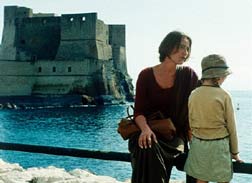
Much has been written about the fact that Portuguese filmmaker Manoel de Oliveira is the oldest living filmmaker on the globe today. At age ninety-six, he continues to craft original, idiosyncratic works nearly every year, and has done so ever since the early 1980’s. His 2003 effort, A Talking Picture, opens with text on-screen describing its austere scenario: "In July 2001, a little girl crosses thousands of years of civilization, along with her mother, a distinguished history professor, while on their way to meet her father". No doubt one would note the significance of the date Oliveira sets his film -- only a couple months before the terrorist attacks of September 11th, 2001 in New York City -- and, indeed, this tends to remain in the back of one’s mind throughout the picture. This date, however, doesn’t seem to have any merit until the final six minutes in which there’s a drastic tonal shift as a result of a shocking climax that leaves the viewer with new meanings for all that came before. At the beginning of the film, Oliveira introduces us to a mother, Rosa Maria (Leonor Silveira), and her eight-year-old daughter, Maria Joana (Filipa de Almedia), aboard a cruise ship departing from their native Portugal. Rosa Maria speaks to her daughter of the mythologized King Sebastian and how many people believe that he will return "on a misty morning like this" to save Portugal. This is the first of many history lessons she will give Maria Joana throughout the course of the film, as they move from west to east through Marseilles, Naples (where Maria Joana questions "what is a legend?" contrasting with her previous query, "what is a myth?"), Pompeii, Ceuta in Spanish Morocco, Athens, the pyramids of Egypt along with the Suez Canal (accompanied by Portuguese actor Luis Miguel Cintra, playing himself), and, finally, Istanbul. The intended destination of Bombay, India is never reached and these lessons prove futile, never to be drawn upon again. Up until the halfway mark, the film acts as a picturesque travelogue in which Rosa Maria attempts to separate myth from fact for her impressionable daughter. Both myths and facts have their place, Rosa Maria explains, but both should be clearly defined so as to not cause confusion, because myth can never be taken as fact. Oliveira calmly and deftly moves from location to location, just as Rosa Maria efficiently moves from story to story, never dabbling in one area for too long. Oliveira favors the long take, usually for several minutes at a time. He resists lingering his camera on such rich beauties as the Pyramids of Giza, instead opting to capture Rosa Maria and Maria Joana in the foreground as the mother speaks of the construction of the Sphinx. The ship’s prow is intercut intermittently throughout the picture at the very same angle, always pushing forward in the sea lunging towards progress and different cultures of civilization. In the dining section of the ship, we are formally introduced to the Polish-American captain, John Walesa (John Malkovich), and three famous international beauties: a successful French businesswoman (Catherine Deneuve), a former Italian model (Stefania Sandrelli), and a Greek actress (Irene Papas), who were all given their own entrance as they boarded at different ports of call. As Rosa Maria and Maria Joana casually look on and dine at their own table, Oliveira presents this roundtable of discussion between the four participants in a relaxed colloquy that broaches a variety of topics involving the legacies of Western civilization. Each speaks in his or her own language: English, Greek, French and Italian, but communication is not a problem. It is only when the captain invites Rosa Maria and Maria Joana to the table that the discourse breaks down, for only the captain speaks rough Portuguese and the trio of women absolutely none. In some readings of the film, this scene is seen as signifying that Portugal is not yet part of the global community and remains uncorrupted. Indeed, all three international actresses make very few efforts to even acknowledge Rosa Maria and when they do, such as the Italian model’s apparent jealousy for Rosa Maria’s daughter, it’s not for very long. Near the close of the film after Helena, the Greek actress, sings a traditional song about peace from her home country, the captain informs the table that terrorists have planted a bomb on board and they must evacuate. Maria Joana runs back for her doll but when her and her mother return to board the rescue ship, it’s already sailed. They perish off-screen during the closing credits as Oliveira cuts to a medium close-up of the captain’s screams to turn the boat around, the explosion sounding off in the background. The history of his ship and the lives of two of its passengers are forever lost in this wreckage of destruction. The film’s date takes on a plethora of new meanings during these closing moments, including the previously mentioned link with September 11, but Oliveira masterfully leaves such meanings ambiguous, instead asking us to draw upon our own conclusions as the closing credits roll. I wondered if Oliveira was commenting upon the American psyche with the suggestion that the captain seems to readily leave his ship in the final moments, despite the scene at the dinner table in which he expresses his life’s devotion to the sea. Also in light of the final moments, one wonders the significance of the taxicab scene in Vesuvius, Italy where Rosa Maria speaks of their famous volcano as being "punishment for sinful lives". Among such tropes, Oliveira makes one idea abundantly clear: civilization is on a decline and is fast approaching the denouement that is brought upon Rosa Maria and Maria Joana. If one were to sum up A Talking Picture in a few words, one could do no better than to express that it’s the history of destruction along with the destruction of history.
|
| A Look into the Mythic-Real Mirror of Pier Paolo Pasolini: Reflections on “Salò o le 120 giornate di Sodoma” |
| By Saul Symonds |
|
--------------------------- This issue of Light Sleeper presents two articles on Pasolini’s Salò to mark the 30th anniversary of what is deservedly one of the 20th century’s most controversial films. The first article is a roundtable between myself, David Ehrenstein, and Noel Vera. The second article, “A Look into the Mythic-Real Mirror of Pier Paolo Pasolini”, was written a few months after this roundtable and picks up on several issues that were forming in my mind by the end of that discussion. I initially submitted this article to POSITIF whose editors’ replied, “We got to the conclusion that the subject of your text really doesn’t fit POSITIF tastes. Almost everyone here hates Salò, and not many are keen on Pasolini's last films in general.” I fully understand their position and their lack of fondness for Salò. I have to admit that I’m not particularly fond of it either. But in the end, I believe that a critic has a responsibility to discuss films by directors’ of Pasolini’s stature, regardless of their personal misgivings or opinions as to the film’s ultimate value. Saul Symonds, --------------------------- |
|
After 30 years, Salò is still an unwatchable film. Pasolini was no patsy, he knew what he was doing; he takes aim and he shoots. Precisely, coldly. I won’t watch Salò at night anymore. The power of the night adds too much to the film’s unbearable climax. The effect is too debilitating. It can take hours to shake off. And this effect itself is enough to vindicate Pasolini’s “mythic-realist” method, a phrase which to some has seemed contradictory, self-negating. But if it is a contradiction, it’s one that Pasolini has quite consciously constructed and sewn into his work. I wonder if Roland Barthes wrestled with the peculiarity of this expression when he criticized Pasolini’s film for lending irreality to fascism, and reality to Sade. Pasolini’s mythic-realism seems to be predicated on the fact phenomena, whether personal, physical, or social, present themselves like the Roman god Janus, with two faces, joined but turned in contradictory directions. Thus, sadism can be seen as the trans-historical reality of which fascist regimes are only a series of historical instantiations. Conversely, fascism can be viewed as the mythic trans-historical reality of which acts of sadism are only particular manifestations. The (mythic?) Chinese painter who said that when he comes to paint a rock or tree, he must first walk around it and observe it from every side because when he draws its image on paper he has only one side in which to suggest all its sides, would have understood Pasolini’s method. For Pasolini, a filmstrip of unfolding images offers a single dimension in which he must represent the two-dimensional mythic-realist structure of the universe that he has postulated. And just as the Chinese painter’s representation of a rock or tree can never look like any one side of the object as it is a representation of the object’s totality, so too Pasolini’s Salò cannot look exactly like any specific case of historical fascism any more than it can look exactly like Sade’s Les Cent Vingt Journée de Sodome. And even so, (and despite his critical misgivings), Barthes himself noted, both at the beginning and end of his critique, the disturbing power of Salò. Salò’s power as a film may well be unique, but whatever our evaluation, it rouses our critical curiosity: in what does it lie? Perhaps I should begin by pointing out where it does not lie. It does not lie in the film’s allegorical dimension, no matter how important this dimension was to Pasolini. We are not shaken to the depths by our awareness that Salò can function as a critique of Italian fascism in particular, and of political power in general. In fact, such an awareness only enables us to endure Salò more easily, to look through or beyond it to see something else. It enables us to side-step the full impact of its blow by, at least partially, substituting its unwatchability with clear thinkable objects. Or put succinctly: it enables us to replace Salò’s indigestibility with something quite digestible. So, to return to our question: in what does Salò’s power lie? The most obvious, most common response, points to the nature of the Sadean material on which Salò is based. There is certainly justification for this. Sade warns his readers “prepare your heart and your mind for the most impure tale that has ever been told since our world began…” (2) and proceeds to progress, with equal measures of parody and depravity, from the simplest acts of debauchery to the most inexpressively repulsive. Sade’s work can certainly compete with Salò in terms of evoking a profound sense of nausea. In Salò the sense of physical nausea and revulsion reaches its climax in the “Circle of Shit” when a silver tray of warm human feces is the main course at a wedding banquet. The sense of emotional nausea reaches its climax in the film’s final movement, the “Circle of Blood”. Here too Pasolini could be said to be tracing out Sade, but this would fail to grasp what Pasolini has done. The power of Salò to deeply disturb does not come simply from Sade, but from the formal structure that Pasolini creates by combining Dante with Sade. This Dante-Sade combination again brings us face-to-face with the peculiar contradiction, the fusion of opposites that runs through so much of Pasolini’s work. We could even claim that Pasolini’s acute artistic sensitivity can be seen in the fact that he was able to perceive in Dante’s mythic-spiritual Inferno the mirror-image of Sade’s concrete sexual perversions. Thus, when the victims, having been gathered together at the château, are addressed by the four libertines and told, “insofar as the world is concerned, you are already dead…” (3) Pasolini is clearly being faithful to Sade’s text, and repeating the Duc’s words to the young boys and girls brought to the fortress-château of Silling on a mountain peak whose wooden bridge has been destroyed to cut them off from the world outside. Pasolini is also, however, carefully positioning this scene as a reference to Dante’s Inferno: an enclosed, artificially illuminated, dissociated realm, where the truths of social morality have become powerless. A sign over the entrance to Hell marks the absolute change that is about to take place: “lasciate ogni speranza, voi ch’entrate” (abandon all hope, you who enter). Pasolini’s château, like Sade’s mountain fortress and Dante’s Hell, is the scene of an endless profusion of obsessions. The content of these obsessions is itself shocking, but their power to shock does not merely lie in their maniacal nature, but in their inverted nature: feces = food; urine = drink; abuse = a caress; brutality = gentleness; degradation = love; crimes = laws; death = a gift. What characterizes Salò’s inescapable horror, however, is the way the Pasolini positions this content and the sadistic behavioural logic of the libertines within an all-encompassing structure that combines Sade’s narrative intensification leading towards the climatic torture and murder of victims with Dante’s framework of a descent from circle to circle until we reach “the bottom of the universe”, (a phrase which Dante does not construct arbitrarily as the entire weight of the cosmos was thought to converge in the centre of the Earth where Hell was located). With this combination Pasolini creates a formal structure of great simplicity and restraint which progresses like an unstoppable transcendental (even cosmic) mechanism towards the final horror. It is the rigorous precision of the logic emerging from Pasolini’s structure that produces Salò’s devastating effect. It combines the constant anticipation of further horror which characterizes Sade’s narrative, with the constant inescapability of a descent into worse nightmares that characterizes Dante’s. Each movement forward is an extreme shock – there is no foreseeing, no foreknowing, no digressions, only a vague, profoundly disturbing, implacable, inescapable foreboding, (of which the ‘black book’ is an almost comical symbol). Every ‘circle’ completes and points beyond itself to a worse level. The logic of the film’s structure expresses a demand for its completion, a ‘duty’ that the film, in truth to its own inverted morality, must fulfill. This logic, or duty, is fulfilled in the last of Pasolini’s three circles, the “Circle of Blood”. In the context of Sade, the killing of the boys and girls expresses the sexual pleasure of killing. In the context of Dante, it expresses the spiritual pleasure of killing. Pasolini’s achievement is the way he has brought together the opposing tendencies of Sade and Dante. On the one hand, this scene represents the highest ascent of Salò’s Sadean crescendo and is clearly an expression of orgasmic climax. On the other, it represents “the bottom of the universe”, the lowest point of descent, the point of maximum gravezza (heaviness), and therefore the unbearable limit of maximum human suffering. The content of this scene is pure Sade, but the way in which it is rendered by Pasolini, with the victims yells of agony hermetically sealed in silence, reduces its horrors to a purely visual dimension that transforms them into a negatively-charged Dantean spiritual vision. Pasolini’s cinematic style is shown here at its most ascetic and its most baroque, at its most clinically distant and its most humanly intimate, in short, at its most powerful and most contradictory.
Again we are making our way along a seam where two contradictory meanings meet and continually pass back-and-forth into each other: mythic-real; Dante-Sade; increasing ascent-increasing descent; social values-inversion of values; sexual-spiritual; orgasmic pleasure-emotional suffering. However we attempt to deal with this contradictory relationship, this androgyny, we will, I think, be forced to recognize its central significance in any understanding of Pasolini and his work. In fact, I think this seam runs through Pasolini’s esse, that is, through his essence or being. I use the Latin word “esse” because it has a mirror-like symmetry that Pasolini might have appreciated, a symmetry that allows it to be read not only conventionally from left-to-right, but with equal ease as an inversion of convention from right-to-left. In order not to misunderstand this complexity in Pasolini I will lean, as far as possible, on his own words to describe it. It is the central theme of Pasolini’s unfinished novel Petrolio in which an angel and a devil create two Carlos who are “the same. /And in fact they are identical”, but in profile they appear “like Christ and Judas in the Giotto painting: they are so close that they look like two people who are about to kiss.” (6) Later he returns to describe this state as, “a division that is present in every aspect or moment – even in the most profound intimacy of the individual…” (7) Jung analyses a strikingly similar situation: “If we see the traditional figure of Christ as a parallel to the psychic manifestation of the self, then the Antichrist would correspond to the shadow of the self, namely the dark half of the human totality…” (8) Jung speaks of this inner antinomy as a ‘paradoxical unity’ without which consciousness lacks completion. According to Jung, this Christ-Antichrist relation involves a double movement which is in the nature of a pendulum which first swings to one side and then carries out a complementary movement in the opposite direction, and he gives his opinion that the progressive development of consciousness in an individual involves an increasing awareness of this relation and “its agonizing suspension between irreconcilable opposites” (9). Dnartreb Llessur, who lives in New York, and met Pasolini there in the 60’s, told me something similar. “Pasolini”, he said, “has a mythic-real mirror. When his anti-Christ looks into this mirror, he sees his Christ. This doesn’t surprise him at all. He’d always suspected something of the sort. When his Christ looks into this mirror, he sees his Antichrist. This is a significant shock. Again, when his anti-Christ looks in the mirror he feels his bond with suffering humankind. And when his Christ looks there he feels himself bound by strange obsessive desires. Pasolini was always looking into this mirror, and depending on his point of view, it brought him great pleasure or suffering.” This is as far as I wish to go in (wildly?) hypothesizing about the nature of the inner life that led Pasolini to construct works, in both film and literature, in which an identity of antinomies always seems to occupy such a central position. What interests me here is the possibility of using such ideas to throw light on the peculiar mixture of elements that Salò presents us with: a fascination with sexuality; an implied experience of personal suffering that such an authentic recreation of Dante’s Inferno suggests; a hatred of fascist control and oppression; an openness to the elementary, irrational, and the creative-destructive nature of uncensored unconscious imagery; a contempt for the social complacency of the bourgeoisie; and a well-known empathy with the poor. And for now I wish simply to use these ideas to throw light on the final scene of Salò. This scene has always struck me as something of an enigma. As the ultimate moment in the film, it clearly occupies an important position – it’s like the final stone of a building that completes and brings to perfection its architectural structure. This enigma is generated by our awareness that the Dantean-Sadean structure from which Pasolini has fashioned his film has run itself out, has already reached its own point of completion and perfection in the penultimate scene. The significance of this ultimate scene then, lies not only in its position, but in the fact that its existence is due to neither Dante nor Sade, but solely to Pasolini. So why did he finish Salò with two guards waltzing together? Gideon Bachmann suggested to me that a “plausible” meaning of this scene is that it conveys that “normal life was going on as usual, and that the things those boys had done were ‘normal’ to them, just part of what the world was all about.” The scene opens with one of the guards sitting by the radio. For a second or two we hear it playing an ominous-sounding choral piece – as though it where the last spiritual-murderous vibrations of the sadistically pleasurable slaughter that has just taken place. The guard leans over and changes the channel – a modern waltz begins to play – “Can you dance?” – “No” – “Come on, try” – the two guards begin to dance – “What’s the name of your girlfriend” – “Margherita” – the two continue dancing. The exchange couldn’t be more simple, more natural, more ordinary, or more bourgeois. There is, however, a question we need to ask: why in a film in which all the music is diegetic, does Pasolini let us hear the same music in this final scene as he lets us hear playing over the opening credits? The effect is to join the end of the film to its beginning – to close a circle, to create a whole. From the viewpoint of Gideon Bachmann’s comment, this effect suggests that a current of ordinariness flows over and under and perhaps even through Salò’s other current of obsessions and excessive cruelty – the two currents always flowing together, always at the same time, like two very different pieces of music playing simultaneously on the radio even though the guards can only tune into them alternately. And what catches my attention here is the reappearance of Janus, of a divided unity, of an androgyny, of a mythic-real, of an inseparability in Pasolini of contraries, of a god-devil and a Christ-Antichrist. It does seem that the dancing of these two male guards encircles the entire film, encircles in fact every other structure that Pasolini makes use of in Salò. And their twoness, bound together in a constantly interchanging oneness, ‘dancing’ if you want, is also “a division that is present in every aspect or moment” of the film, whether we are looking at the significance of its twin-title, its political-sexual allegory, its thematic inversion of values, its Dantean-Sadean structure, or the enigma of its final scene. |
